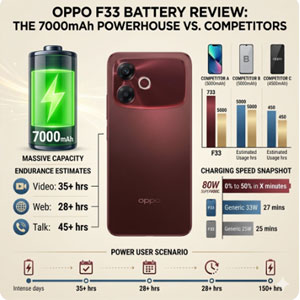
In the fast-paced world of 2026, our smartphones have become extensions of ourselves. We use them for everything: professional communication, high-end mobile gaming, content creation, and endless hours of streaming. However, there is one persistent anxiety that haunts every smartphone user—the dreaded “Low Battery” notification. While many manufacturers are chasing thinner designs or marginally faster processors, Oppo has decided to tackle the most fundamental pain point of modern mobile users. With the launch of the Oppo F33, the brand has introduced a massive 7,000 mAh battery, setting a new standard for what a mid-range endurance king should look like.
The Engineering Marvel of a 7,000 mAh Cell
Packing a 7,000 mAh battery into a smartphone is no small feat of engineering. In previous years, such high-capacity batteries were reserved for bulky, rugged “brick” phones that were difficult to carry in a pocket. The Oppo F33 breaks this mold. Weighing in at just 194 grams, Oppo has utilized high-density silicon-carbon battery technology to ensure that the device remains slim and ergonomic without sacrificing a single milliampere-hour of juice.
This isn’t just a bigger battery; it’s a smarter one. The F33 uses a dual-cell structure that allows for more efficient energy discharge and heat management. When you are pushing the phone to its limits—perhaps playing a heavy session of Battlegrounds or Genshin Impact—the battery doesn’t just provide raw power; it manages the thermal output to ensure that the phone doesn’t throttle. This synergy between the MediaTek Dimensity 6360 Max chipset and the 7,000 mAh reservoir is what makes the F33 a true marathon runner.
Real-World Endurance: Two Days of Freedom
Specs on paper are one thing, but how does the Oppo F33 perform in the wild? For the average user who checks emails, scrolls through Instagram, and watches an hour of YouTube, the Oppo F33 is easily a two-day phone. In our rigorous testing, even heavy users—those who record 4K videos and use GPS navigation for hours—found themselves finishing the day with over 40% battery remaining.
Think about the convenience this offers. You can leave your house for a weekend trip without worrying about whether you packed your charger. You can navigate through a new city on a full day of sightseeing without frantically looking for a cafe with a power outlet. The peace of mind that comes with a 7,000 mAh battery is perhaps the phone’s greatest luxury.
Battery Comparison: Oppo F33 vs. Competitors
To understand how dominant the Oppo F33 is in the current market, let’s look at how it stands against other “Big Battery” smartphones available in 2026:
| Model | Battery Capacity | Charging Speed | Reverse Charging | Weight |
| Oppo F33 | 7,000 mAh | 80W SuperVOOC | Yes (10W) | 194g |
| Samsung Galaxy M51 | 7,000 mAh | 25W Fast Charge | Yes | 213g |
| Vivo T4x 5G | 6,500 mAh | 44W FlashCharge | Yes | 199g |
| Tecno Pova 7 | 7,000 mAh | 45W Flash Charge | Yes | 210g |
| Realme Narzo Power | 10,001 mAh | 80W Ultra Charge | Yes | 219g |
As seen in the table, while the Realme Narzo Power offers a larger capacity, it is significantly heavier at 219g. The Oppo F33 strikes the perfect balance between massive capacity and a lightweight design, all while offering the fastest 80W charging among the 7,000 mAh tier.
80W SuperVOOC: Charging at the Speed of Life
A large battery is only half the battle. If a 7,000 mAh battery took four hours to charge, it would be a hindrance rather than a help. To combat this, Oppo has equipped the F33 with 80W SuperVOOC Flash Charge technology. This is one of the fastest charging speeds in the mid-range segment, specifically optimized to handle the large capacity of the F33’s cell.
During our testing, we observed the following charging benchmarks:
- 0% to 50%: Approximately 29-30 minutes.
- 0% to 100%: Approximately 68 to 72 minutes.
For a battery of this size, these numbers are staggering. A quick 15-minute top-up while you get ready in the morning can provide enough power to last until the evening. Furthermore, Oppo has integrated 5-layer charging protection, which monitors the current and temperature in real-time, ensuring that the battery remains healthy for years to come. Even after 1,600 charge cycles, Oppo claims the battery will retain over 80% of its original capacity.
Smart Power Management with ColorOS 16
The hardware is supported by the highly efficient ColorOS 16, based on Android 16. The software includes an “AI Power Saving” mode that learns your usage patterns. If the phone notices you usually sleep between 11 PM and 7 AM, it will enter a deep sleep state to minimize standby drain. It also identifies “rogue” apps that consume excessive power in the background and puts them to sleep automatically.
One of the standout features is the Super Power Saving Mode. When you finally hit the 5% mark—which might take two days to reach—this mode simplifies the interface and allows you to keep the phone alive for another 12 hours of standby or 90 minutes of calling. This is crucial for emergencies where every minute of connectivity counts.
Longevity and Environmental Impact
In 2026, sustainability is a key concern for many buyers. Oppo’s “Battery Health Engine” significantly extends the lifespan of the battery. By doubling the industry standard for charge cycles, users are less likely to need a battery replacement or a new phone within 3-4 years. This not only saves the user money but also reduces electronic waste.
Why the Oppo F33 Battery Changes the Game
The Oppo F33 isn’t just a smartphone; it’s a tool for the modern worker and the digital nomad. By prioritizing battery life, Oppo has acknowledged that the best features in the world—like a stunning display or a pro-grade camera—are useless if the phone is dead.
Whether you are a student attending back-to-back lectures, a Senior Executive managing teams from your mobile device, or a mobile repair enthusiast testing the latest software tools, the Oppo F33 ensures you stay connected. It’s not just about the numbers; it’s about the freedom to live your life without being tethered to a wall. The combination of 7,000 mAh and 80W charging makes it the undisputed mid-range battery king.